Entrepreneur Portrait
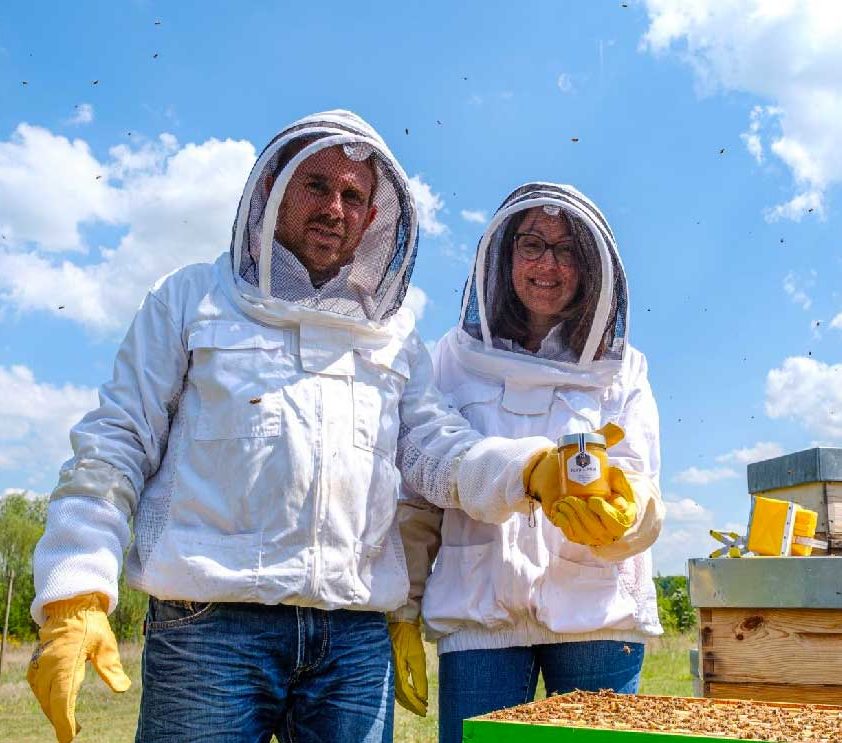
A farmer by trade and a beekeeper by passion, Sébastien has successfully diversified his family farm by creating “Peau de Miel.” Navigating between resilience in the face of the weather and the challenges of entrepreneurship, he shares his unfiltered journey with us.
Global Vision and Daily Life
Sébastien, for those who don’t know you yet, how do you introduce yourself today and what is your main activity?
I introduce myself as a farmer and beekeeper, and the creator of a cosmetic brand called “Peau de Miel.” When presenting it to clients, I use a play on words with the brand name to explain its identity: “Peau de Miel” [Honey Skin], but “Peau” like the skin on your body—and I show the skin on my hand to illustrate it.
What does a typical day look like in your shoes as a leader/entrepreneur?
There is no typical day; that’s the unique thing about it. What defines my tasks for the day is the weather. It’s a hurdle for scheduling appointments because if the weather is good for working outside in beekeeping or farming, it’s tricky to cancel meetings at the last minute. It’s extremely complicated when the schedule is very tight.
What are the main difficulties of being a beekeeper, farmer, and entrepreneur?
Entrepreneurship and the creation of Peau de Miel was a real challenge. It has been almost 6 years since I launched the cosmetic brand. I had to gain skills in many different sectors to develop the brand.
How do you manage the balance between your professional and personal life?
I don’t have the time to manage it; that’s the problem.
Customer Relations and Retail Experience
How is the collaboration with other members or the companies you work with?
We don’t really “collaborate” in the traditional sense; I work with partners who produce my cosmetics, and we operate on a very long-term basis. For the soaps, it generally takes 4 months between the order and the receipt of the products. This is because we use cold saponification, and the soaps need to cure for two months before being sold. Therefore, a lot of anticipation is required to avoid stockouts.
How do you handle the unexpected (stockouts, delivery issues)?
It happens sometimes, and it’s frustrating. As a result, we slow down sales by reducing communication, but consequently, we don’t generate revenue on those products.
How do you define customer relations at Peau de Miel?
My main concern regarding customer relations is aiming for B2B development. I am constantly looking for new clients for gift sets, because a company that gives a gift set to its employees one year will want to change the next; so, it’s hard to build loyalty there.
How do you adapt your pitch depending on the client?
I meet them at their level. There is a lot of education involved regarding bees. It’s a vast world that interests people a lot, so communicating on this subject is fairly simple.
What future developments do you envision for Peau de Miel?
Growth, over the medium to long term, notably through the development of a new range, such as face cream.
Can you tell me about a memorable experience with a client?
Yes, for example, a client discovered me through a flyer at an event. There was a mention of our brand in a local gazette, and this client found me on a Sunday evening while browsing the magazine. He called me Monday morning; he was in a big hurry because he had a staff committee meeting to present ideas for Mother’s Day gift sets. While talking to him, I immediately felt over the phone that even before he had seen my products, the sale was already made.
Academic Background
What was your background in terms of studies or training?
I went to agricultural school and finished with a high school vocational level (Bac) to take over the family farm in 2002. Alongside that, I’ve always been very proactive and worked for other companies. Later, I became self-taught for the creation of Peau de Miel. My wife and I did a custom training course at home. It allowed us to brainstorm the project together. Since then, I’ve been self-taught (thanks to YouTube in particular) and I learn as I go through the missions I have to complete. I’ve also progressed tremendously since joining a business club in Paris.
Looking back, which skill learned during your training/studies serves you most today?
None of my studies directly applied to the diversification and creation of the cosmetic brand. However, I believe that thanks to school, I am able to perform case analyses, particularly in daily farming. It’s a job where you have to react quickly in all circumstances; as I said at the beginning, everything is linked to the weather, and when you need to be ready, you have to be ready.
What made you want to become a farmer and then an entrepreneur?
Becoming a farmer wasn’t necessarily a “desire”; it was more of a heritage (the farm was passed down from my grandfather, to my father, then to me). It was a search for diversification of the main agricultural activity.
What professional qualities are needed to succeed in what you do?
Resilience. There are problems all the time, but you always have to keep going, be persistent, and never give up.
Expertise and Advice
What was the trigger that made you want to start your business?
I’ve always loved bees. Early on, there was a beekeeper who came to my farm every year. In 2018, I spoke with him because I was becoming more and more interested, and he told me he was stopping. I thought to myself that it was the perfect time to start.
If you had to define the “common thread” of your career in one word or phrase, what would it be?
“By some misunderstanding, it might just work”—that’s a bit of a humorous note! What you have to understand is that you shouldn’t be afraid to dare; don’t hold yourself back, just act! We have doubts all the time, but you have to manage to overcome them and keep moving forward.
If you had the 20-year-old Sébastien Goiset in front of you, what advice would you give him to succeed in today’s world?
To work harder at school, because I wasn’t academic at all.
Do you regret it?
No, it’s not a regret, but it would have allowed me to move faster.
And finally, what advice would you give a student who wants to get into entrepreneurship?
Be curious and get up in the morning, because the morning is when you win your day.
“By some misunderstanding, it might just work… you shouldn’t be afraid to dare, don’t hold yourself back, and take action!”